Forex trading for beginners versus chasing random strategies and why a market-structure approach wins
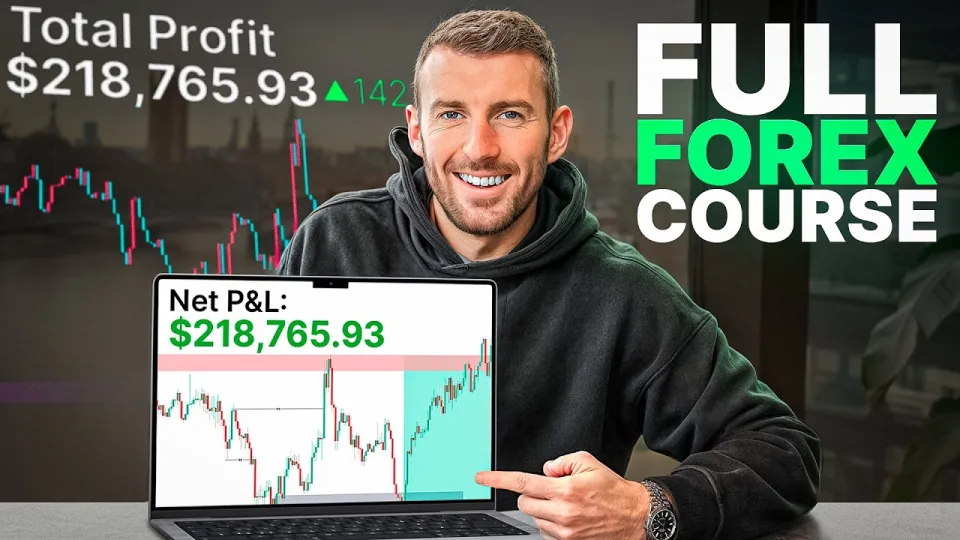
Video: Beginners Guide To Forex Trading In 2026 (+3 hours)
You can order the same kind of articles for your own video to boost it on YouTube and Google. Just message the Telegram bot @sat_sit_bot. It writes articles around your video, embeds the video and publishes them on popular niche websites (no ads). Free trial — 50 articles.
· based on the channel Matt Donlevey - Photon Trading
Key takeaways
- Forex is the largest market in the world: spot FX turns over roughly $7.5 trillion per day, according to the BIS 2022 survey.
- Matt Donlevey's free course runs over three hours and covers bid/ask, orderbook, auction market theory, orderflow, market structure, entries, management and psychology.
- The core claim of the guide is that geometric chart patterns do not explain price movement — orderflow and liquidity do.
- Retail leverage is capped at 30:1 in the EU and UK and 50:1 in the US for major pairs, so position sizing matters more than entry precision.
- A written trade plan, backtesting and a journal are presented as non-negotiable steps before risking real capital.
Forex is the market where currencies are quoted in pairs and traded over the counter, and the best way for a beginner to approach it is to learn how price actually moves — through liquidity, orderflow and market structure — rather than collecting chart patterns. Matt Donlevey's Photon Trading guide "Beginners Guide To Forex Trading" builds exactly that foundation, and the accompanying free Photon Trading course and cheatsheets cover the same material in written form.
The distinction matters because most beginner material starts with indicators and candlestick names, then jumps to entries. Donlevey inverts the order: first the mechanics of the market, then a strategy built on those mechanics, then risk and psychology. This article walks through that sequence and explains what a newcomer should actually do with it.
What forex trading actually is and who is on the other side
Forex is a decentralised network of banks, brokers, funds and retail traders exchanging currencies, with no single exchange and no closing bell. The most traded pairs — EUR/USD, USD/JPY, GBP/USD — account for the bulk of volume, and liquidity concentrates in the London and New York sessions. The BIS Triennial Survey put daily spot turnover at about $7.5 trillion in 2022, which is why spreads on major pairs are measured in fractions of a pip.
That size creates a specific problem for retail traders: you are a small participant in a market driven by order flow from institutions. A beginner's edge cannot come from predicting news; it comes from reading where resting orders sit and how price reacts when those orders are consumed. This is the premise the Photon Trading course is built on, and it is why the guide spends its first hour on bid, ask, spread, the orderbook and auction market theory before showing a single trade.
Why technical analysis alone fails beginners
Technical analysis fails as a standalone method because a triangle or a head-and-shoulders shape has no causal link to why buyers or sellers step in at a given price. Donlevey's critique is blunt: geometric shapes do not explain price movement, so a strategy built only on shapes has no market logic behind it. The alternative is to treat the chart as a record of transactions — where liquidity was taken, where it was left untouched, and which side was forced to close.
Concretely, the guide replaces pattern-spotting with three questions:
- Where is the current market structure — higher highs and higher lows, lower highs and lower lows, or a range?
- Where is price relative to the range — in premium (expensive) or discount (cheap) territory?
- Where is the liquidity that a move would need to reach before reversing?
Those three questions produce a repeatable framework, and they can be answered on any timeframe, which is what makes multi-timeframe analysis useful rather than confusing.
The market microstructure every beginner should learn first
Market microstructure is the plumbing of forex: the bid is the price at which you can sell, the ask is the price at which you can buy, and the spread is the difference you pay on entry. On EUR/USD at a good broker that spread might be 0.1–0.5 pips, but on exotic pairs or during news it can widen several times over, which quietly destroys short-term strategies.
The orderbook matters because price does not move in a vacuum — it moves when aggressive market orders consume passive limit orders resting at a price. Auction market theory describes the same process from the outside: the market auctions up and down until it finds a price where buyers and sellers agree, and it accelerates when it finds a level where they do not. Orderflow is the record of which side is being aggressive. A beginner who understands these three layers stops asking "what is the pattern" and starts asking "who is trapped here".
How much money a forex trader can realistically make
Realistic forex returns depend on risk per trade and the number of trades, not on leverage or account size. A trader risking 0.5–1% per trade with a 1:2 reward-to-risk ratio and a 45–50% win rate can compound steadily; the same trader risking 10% per trade will be wiped out by an ordinary losing streak of five or six trades, which happens regularly even with a genuine edge.
The guide is honest that most beginners lose money in their first year, and that the path to consistency runs through backtesting, a written trade plan and a journal rather than a bigger position size. Prop firm funding — trading other people's capital for a profit split — is presented as a legitimate route for traders who can demonstrate a tested process, but it demands the same discipline plus strict adherence to drawdown rules.
The Photon Trading strategy in plain terms
The Photon Trading approach is a market-structure and liquidity framework rather than an indicator system, and it can be summarised as a sequence of filters. First, identify the prevailing structure on a higher timeframe and mark the last significant swing points. Second, locate premium and discount zones within the current range and refuse longs in premium or shorts in discount. Third, mark supply and demand zones where price previously left imbalance, and note the liquidity resting above equal highs or below equal lows.
Entries come when price sweeps that liquidity and then shows a structural shift on a lower timeframe, giving a defined invalidation point. Trade management follows the same logic: partials at the next opposing liquidity pool, stop moved only after structure confirms, and no widening of risk. Money management is capped in advance — a fixed percentage per trade and a maximum daily loss — so that a bad session cannot undo a good month.
Common beginner mistakes and how to avoid them
The three mistakes that sink most new forex traders are over-leveraging, strategy-hopping and trading without a plan. Over-leveraging is the fastest killer: with 30:1 leverage in the EU and UK and 50:1 in the US on major pairs, a $1,000 account can control $30,000–$50,000, and a 2% adverse move on that notional is a 60–100% loss of equity. Strategy-hopping comes from judging a method on ten trades instead of a hundred. Trading without a plan means every loss becomes an emotional event rather than a data point.
The remedy is unglamorous: write a trade plan that specifies pairs, sessions, setup criteria, risk per trade, maximum daily loss and review schedule; backtest the setup over at least 100 historical examples; journal every trade with a screenshot and a one-line reason; and review the journal weekly. Choosing a broker belongs in the same plan — regulated entity, tight spreads on majors, reliable execution, and a clear cost structure including spread, commission and swap.
What viewers still ask about learning forex
Viewers of the guide repeatedly raise the same doubts, and they are worth answering directly. One is pace: a three-hour course moves quickly, and non-native speakers in particular report struggling to follow, so slowing playback and taking notes per section works better than watching in one sitting. Another is sequencing — whether to study psychology first or strategy first. The practical answer is strategy: build a tested edge, then work on executing it calmly, because psychology without an edge is just managing randomness.
A third recurring theme is whether free material can be as good as paid courses. The content of a systematic curriculum — microstructure, structure, liquidity, risk, journaling — is what determines value, not the price tag, and the same topics appear in paid programmes. Finally, experienced traders say they still pick up details on market dynamics after years, which is a reminder that the material rewards re-watching rather than a single pass.
Useful links
- Free Photon Trading course and cheatsheets
- Photon Trading mentorship programme
- Photon Trading Telegram channel
- Photon Trading on Instagram
Final thoughts on starting forex the right way
Forex rewards traders who understand why price moves before they try to profit from it, and the Photon Trading guide is a structured route to that understanding. Its value lies in the order of topics: market mechanics first, then structure and liquidity, then entries, risk and psychology. A beginner who works through it slowly, backtests each concept and keeps a journal will be far better prepared than one who memorises candlestick names. Matt Donlevey - Photon Trading deserves credit for publishing a full curriculum openly, and the free course download is the natural next step after watching.
Source: Beginners Guide To Forex Trading In 2026 (+3 hours) · Markdown version
Questions & answers
How long does it take to learn forex trading properly?
Most traders need six to twelve months of study and demo or small-live practice before results become consistent. The realistic sequence is market mechanics, a tested setup, backtesting over at least 100 trades, then live execution with small risk. Skipping the backtesting stage is the most common reason beginners restart from zero.
Can you make money in forex with a small account?
Yes, but the constraint is risk per trade rather than account size. Risking 0.5–1% per trade on a $500 account means $2.50–$5 of risk, which limits position size but still allows a genuine edge to compound over time. Large leverage on a small account is the fastest route to losing it.
Should I learn trading psychology before or after building a strategy?
Build and test the strategy first, then work on psychology. Discipline only produces results when there is a proven edge to execute; before that, emotional control has nothing reliable to protect. Once backtesting shows a positive expectancy, journaling and routine become the main levers.
Is free forex education good enough compared with paid courses?
It can be, because the deciding factor is whether the curriculum covers market microstructure, structure, liquidity, risk management and journaling in a systematic order. A three-hour structured guide that covers all of those is more useful than a short paid course on one indicator. Paid mentorship mainly adds accountability and feedback.